
Why Your Shop Is Running at 60% OTD (And How to Fix It)
Most shops think their problem is capacity. But the real issue? The system that decides what runs next is fundamentally broken.
TL;DRKey Takeaways
- Most shops plateau at 60–70% OTD — this is normal, not a failure
- Humans can't reason across months of shop complexity
- Local decisions (running quick jobs, finishing setups) break global delivery
- Recomputing the schedule as reality changes lifts OTD to 80%+
- Skody AI acts like a chess engine for production scheduling
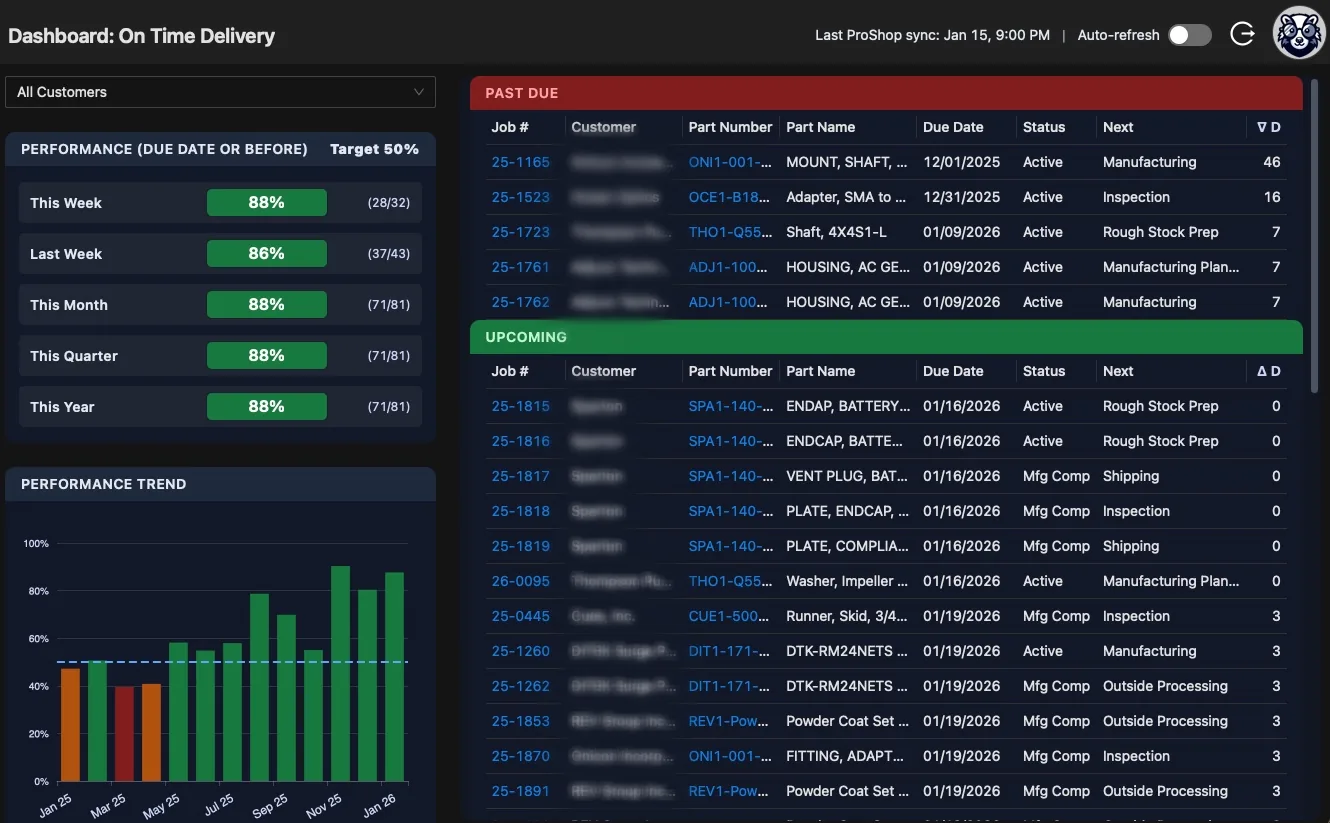
Most shops I walk into think their problem is capacity. They're not shipping on time, customers are escalating, planners are stressed—and the instinctive answer is: "We need another machine."
But when you look closely, a different pattern emerges.
Across high-mix, low-volume manufacturing shops, On-Time Delivery (OTD) almost always plateaus between 60–70%. Not because teams don't care. Not because machines aren't capable. But because the system that decides what runs next is fundamentally broken.
The 60–70% OTD Plateau: A Structural Problem
If your shop is sitting at ~60% OTD, you are not underperforming relative to your peers. You're normal.
That plateau exists because most shops operate with:
- Static ERP schedules
- Human-driven prioritization
- Fragmented visibility across machines, materials, and due dates
- Local optimization instead of global flow
The system is working exactly as designed—it's just designed for a world that no longer exists.
Why OTD Breaks Down in Real Shops
1. Humans Can Only See 1–2 Weeks Ahead
Even the best schedulers can only reasonably plan for today, tomorrow, and maybe the next week. Three weeks out, you're already guessing which jobs will finish on time, which inspection queue will clog, and which "hot job" will preempt everything. Four months out? The schedule becomes a story, not a plan.
2. Local Decisions Quietly Destroy Global OTD
Most late orders aren't caused by one big failure. They're caused by hundreds of reasonable local decisions:
- "Run this quick job now, it's almost done"
- "Let's finish this setup since we're already here"
- "That job isn't due for a while, we'll get to it"
Each decision makes sense in isolation. Collectively, they starve downstream operations and push critical jobs past the point of recovery.
3. ERP Schedules Have a Half-Life of Hours
ERPs assume static routings, don't re-optimize continuously, and don't understand cascading effects. Once reality deviates—a late setup, a rework loop, a missed shift—the ERP schedule becomes fiction. That's why the real schedule lives in whiteboards, sticky notes, and someone's head. And that's exactly where OTD goes to die. This is why shops need tools that optimize production schedules again whenever reality changes.
4. You're Optimizing Utilization, Not Flow
Shops often chase spindle utilization and "no idle time." But OTD doesn't care about local utilization. OTD cares about the critical path—the sequence of constraints across the entire shop. A machine running the wrong job at the wrong time can be 100% utilized and still make you late.
The Scheduler's Dilemma
Here's the core problem: a scheduler is being asked to solve a problem that is too large for the human brain. This isn't an intelligence issue—it's a complexity issue.
A real shop schedule includes:
Every change ripples. This is not a spreadsheet problem. It's an optimization problem.
What Actually Breaks the OTD Ceiling
To move from 60% → 80% OTD, shops need three things:
1. A Schedule That Sees the Entire Board
All active work orders, across all machines, over months—not days. This is the only way to see which jobs are quietly becoming impossible and where bottlenecks will form. Real-time manufacturing dashboards make this visible at a glance.
2. Re-Optimization When Reality Changes
Reality changes constantly. A static schedule decays immediately. What's required is a decision loop that runs again whenever reality changes: sense real progress, recompute priorities, decide what runs next, execute, repeat.
3. Trusting the System
OTD doesn't improve until the shop actually listens to the optimized schedule. Partial adoption = partial results. Breakthroughs happen when teams say: "Let's trust the schedule—and measure the outcome."
Real Example: 60% → 80% OTD in 90 Days
When one customer came in, OTD was hovering around 60%. Expediting was constant. Schedulers felt blind past two weeks. The machines weren't the problem—the decision system was.
No new machines. No extra shifts. Just better decisions, made earlier.
See how shops improved OTDThe Mental Shift That Unlocks OTD
The biggest transformation isn't technical. It's mental.
Shops that break through stop asking:
"How do we keep everyone busy?"
They start asking:
"What decision right now protects OTD three months from now?"
That's a different game.
See Your OTD Risk Before It's Late
Most schedulers can see two weeks ahead. Skody AI shows you three to four months — across every open work order.
If you're stuck at 60% OTD, the problem isn't effort. It's visibility.
Related Articles
How to improve on-time delivery in manufacturing
Five scheduling changes that move OTD.
Three Sigma Manufacturing: From Days to Seconds
See how one shop extended their planning horizon from 1 week to 1 year.
AI Optimization Engine
Learn how Skody AI schedules around constraints automatically.
Manufacturing Scheduling Software
Purpose-built production scheduling software for discrete manufacturers.
Job Shop Scheduling Software
Built for high-mix environments with constant change.
CNC Scheduling Software
Maximize machine throughput and reduce setup time.