
Every other system hands the conflict back to you
They'll build the schedule forward or backward. But the moment two jobs need the same machine on the same day, you get a Gantt chart, drag-and-drop, and a million possible arrangements. One of them is good. Go fish.
Skody resolves due-date conflicts first, optimizes throughput second, then checks the plan is actually manufacturable — material on hand, outside processing back in time, someone qualified on the machine. At Three Sigma the planner accepts the computed baseline about 99% of days.
- ITAR-Ready
- Gov Cloud
- SOC 2
- Type II
Click above to explore Skody AI hands-on
What is real-time production scheduling?
Real-time production scheduling recomputes the manufacturing schedule from the live state of the floor — machine status, labor coverage, material readiness, completed operations, and outside processing — instead of from a static ERP snapshot. It runs on demand, on a significant ERP event, or continuously where wired, so the dispatch list at each work center reflects current reality rather than last night's plan.
How it works
- •Live reads from ERP and MES (work orders, completes, inventory).
- •Finite capacity model across machines, tooling and outside processing, plus labor and pallets on the Plant & Enterprise plan.
- •Event-driven replan: machine down, hot job, material slip, scrap, ECO.
- •Stability constraints preserve jobs in setup or in-process.
- •Live dispatch list rendered per work center, with diff visible to planners.
Why it matters
A schedule rebuilt only nightly is wrong by 9 a.m. and useless by lunch. Planners absorb the gap with 3–4 hours per day of spreadsheet rework, and operators run from gut feel. Real-time scheduling closes the gap structurally — it is what allows OTD to climb out of the 60s and 70s and stay above 90% in a high-mix environment.
How Skody does it
Skody recomputes the whole shop in under a minute — on demand or when a significant ERP change lands — preserves stability where possible, and publishes the current dispatch list to each work center. Planners review exceptions; the floor sees one current sequence; managers see at-risk jobs before they slip.
Sound familiar?
- Manual scheduling eats planner time every day
- Rush jobs break the plan by noon
- Setup batching lives in someone's head
- Material or outside processing delays show up too late
- One late work center cascades across delivery dates
With Skody AI Scheduler
- Build an executable schedule in minutes
- Schedule around labor, setups, vendors, and constraints
- Recompute when priorities shift
- Surface bottlenecks and at-risk work earlier
- Keep planner override and manual control when needed
Built for how discrete manufacturers actually run
Recompute in under a minute
Recompute the whole shop on demand, on a significant ERP change, or continuously where it's wired that way — without rebuilding anything manually.
Labor + skill aware
On the Plant & Enterprise plan, schedule based on who is available, trained, and actually able to run the work.
Setup-aware flow
Reduce changeover waste while still protecting delivery priorities.
Material + outside processing
Plan around vendor dependencies, missing material, and external steps that affect release timing.
Bottleneck visibility
See where the constrained work center is and which jobs it threatens next.
Scheduling is only useful if you can see where it breaks
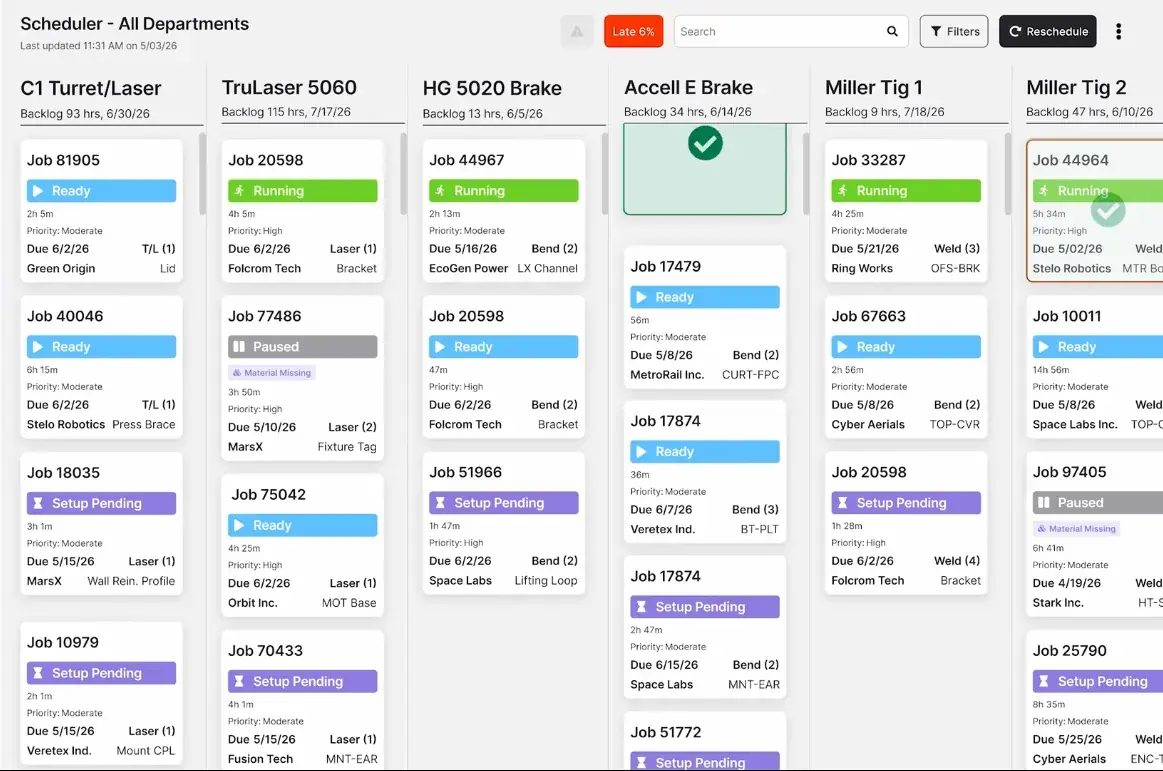
Skody AI does not just generate a plan. It shows the constrained work center, queued jobs, assigned workers, and due-date impact — so your team can act before late work spreads.
Not just a schedule — a live view of where capacity is breaking down.
You still run the shop
Skody gives you the route. You're still driving.
Override anything. The next recompute picks up what the shop actually did rather than insisting on what it told you to do.
Skody AI supports planner judgment. It does not replace it.
See the Scheduler on your real shop conditions
We'll show how Skody AI handles your labor mix, setups, routing, and scheduling pressure — using a workflow relevant to your operation.
Frequently Asked Questions
Questions about labor-aware scheduling, materials, setups, or planner control? Start here.
Manual production scheduling takes 4-6 hours per day for the average job shop with 50-100 active jobs.
Time breakdown:
- Reviewing new orders: 30-45 minutes
- Drag & drop scheduling: 2-3 hours
- Checking constraints: 1 hour
- Shop floor communication: 1 hour
- Re-scheduling rush jobs: Ongoing
With AI: Skody AI reduces this to minutes by automatically optimizing around constraints.
No — you stay in control. Skody AI's AI builds the schedule, but you review and approve before anything goes live.
- Tweak individual jobs
- Drag & drop to adjust
- Switch to full manual mode
- Override any constraint
Your shop, your rules, your exceptions.
Skody AI optimizes around hundreds of constraints simultaneously — something no human planner can do manually:
- Machine availability and capabilities
- Operator skills and shifts (Plant & Enterprise)
- Setup/changeover times
- Material dependencies
- Vendor lead times
- Customer due dates
- Custom business rules
Absolutely. Every job can be manually adjusted:
- Lock specific jobs in place
- Force a job to a particular machine
- Ignore a constraint when you know better
- Take full manual control anytime
Skody AI will re-optimize around your decisions.
Looking for a deep dive on manufacturing scheduling software for job shops? Read our complete guide
Why teams trust the schedule
A schedule is only useful if you can see what is constraining it, what is ready to run, and where labor is overloaded.
Bottleneck visibility
See the constrained work center, the queued jobs behind it, the assigned workers, and the delivery impact in one view.
Material-aware scheduling
Know whether work is actually ready to run. Skody AI surfaces material status, arrivals, shortages, and dependencies before they become shop-floor surprises.
Worker-aware capacity
On the Plant & Enterprise plan, see who is overloaded, where labor is underused, and how upcoming work is distributed across the team.
Not just a schedule — a live view of where execution can break.