


Skody AI vs PlanetTogether at a Glance
Both platforms help manufacturers create realistic schedules rather than relying on unlimited theoretical capacity. The main differences are product focus, implementation approach, scheduling workflow, and ERP environment. For many high-mix shops the deciding difference is people scheduling: how each product puts qualified operators into the same plan as the machines, and whether one person can cover several machines at more than one skill level. Skody also schedules pallet and tombstone automation as a resource; PlanetTogether does not.
| Capability | Skody AI | PlanetTogether APS |
|---|---|---|
| Primary fit | High-mix discrete manufacturing, CNC shops, job shops and fabrication | Broad manufacturing APS, including larger and multi-site operations |
| Finite capacity scheduling | Yes | Yes |
| Machine capacity constraints | Yes | Yes |
| Pallet and tombstone automation | Yes (Plant & Enterprise) — pallet pools, tombstones and multi-part setups scheduled as one resource | No |
| Labor and skills scheduling | Yes (Plant & Enterprise) — qualified operators, skills, certifications, shifts and absences scheduled with machine capacity | Yes — a person is scheduled as a resource; labor, skill, crew and shift constraints, often pulled from a labor or workforce scheduling system |
| One operator across several machines | Yes (Plant & Enterprise) — a person can be scheduled across more than one machine in the same plan, so one operator can cover a cell | No — a person is scheduled as one resource, not shared across several machines |
| Skill-level priority | Yes (Plant & Enterprise) — operators carry skill labels and can hold more than one skill level; work is prioritized to the most qualified person available | No — no per-operator skill levels driving job priority |
| Re-planning | Continuously recomputes based on current production data | Supports rescheduling, updates and what-if scenarios |
| Scheduling approach | Automated optimization using live constraints, with planner controls | Configurable APS with sequencing methods and planner controls |
| ERP connection | Existing ERP remains system of record; live integrations include ProShop, Fulcrum and JobBOSS² | Bi-directional integration; published examples include SAP, Oracle, Microsoft Dynamics, Infor and Epicor |
| Deployment | Cloud scheduling service | Client-server architecture with cloud or on-premise server options |
| Multi-site scheduling | Yes (Plant & Enterprise) | Yes |
| Entry pricing | From $1,500/month for machine-only cells with fewer than 10 machines | Contact PlanetTogether for pricing |
| Larger deployments | Custom pricing based on scope | Quote-based |
| Customer references | Available upon request | Ask PlanetTogether for references relevant to your manufacturing environment |
Rows marked “(Plant & Enterprise)” describe Skody's Plant & Enterprise plan, which is scoped separately — they are not part of the $1,500/month Shop plan. PlanetTogether's published integration examples are not an exhaustive list. The “No” entries for pallet and tombstone automation, one operator shared across several machines, and per-operator skill levels driving priority come from Skody's direct evaluation of PlanetTogether's scheduling model; PlanetTogether's public pages reviewed do not describe those capabilities either. Source: PlanetTogether's own FAQ (planettogether.com/aps-software/faq), finite capacity scheduling page (planettogether.com/finite-capacity-scheduling-software) and integrations page (planettogether.com/aps-software-integrations), checked October 2026.
See How the Scheduling Experience Compares
Both platforms can build finite-capacity schedules. The practical difference to evaluate is how each helps your production team understand conflicts, make decisions and keep the schedule current.
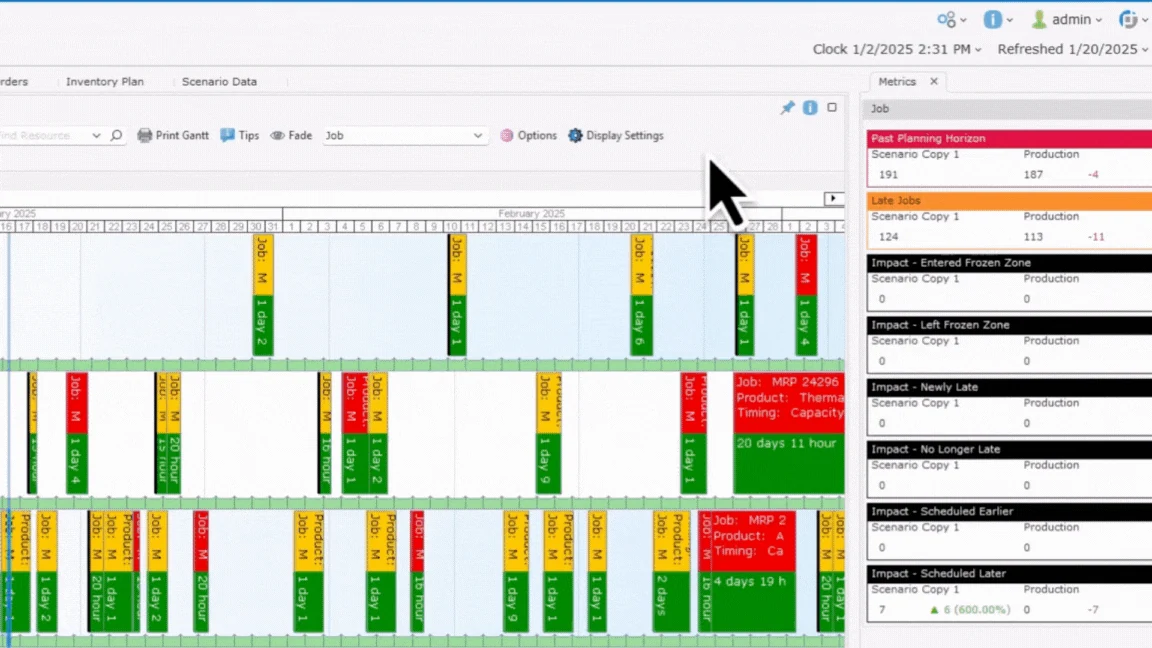
Example interface, January 2025
PlanetTogether APS — Gantt scheduling interface with job-level metrics and scenario comparison.
Explore production sequences, evaluate planning scenarios and review scheduling metrics in a detailed APS workspace.
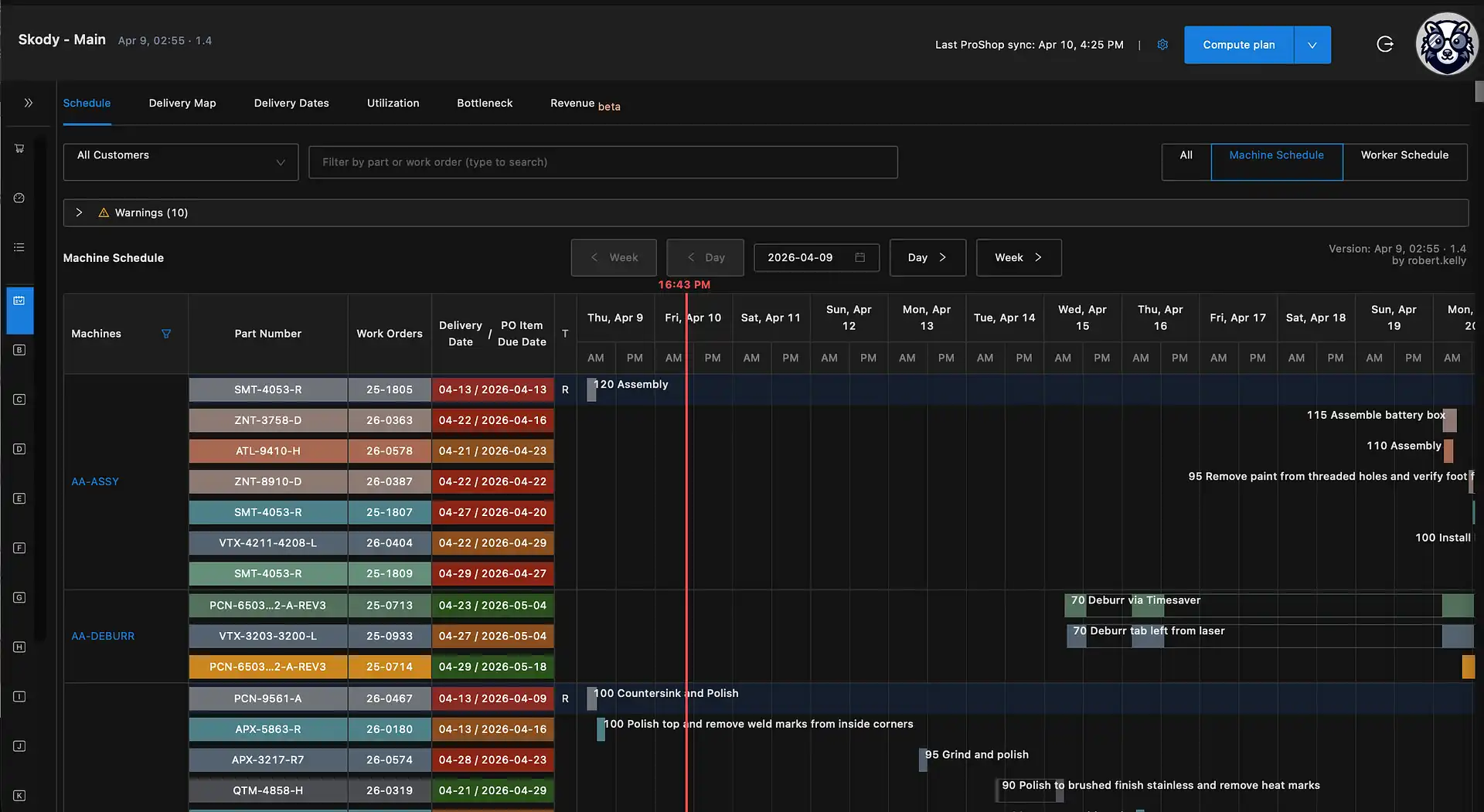
Skody AI — Automatically optimized production schedule with shop-floor constraints and delivery visibility.
Skody computes the production sequence against available machines, labor, skills and other constraints, helping planners focus on exceptions rather than manually resolving every conflict.
Explore Skody Scheduler · Bottleneck and on-time-delivery views
The Real Comparison: What Happens When the Schedule Changes?
Ask both vendors to demonstrate the same production disruption: a machine becomes unavailable, an urgent customer order arrives, and a qualified operator is absent. Compare the resulting delivery dates, production conflicts, scheduling effort and steps needed to publish a usable plan.
- How much manual adjustment is required after rescheduling?
- Which customer orders will become late, and why?
- Does the schedule respect machine, labor, material and setup constraints?
- How quickly can the updated plan be shared with production?
Built for the Shop Floor That Changes Every Hour
In a high-mix manufacturing shop, the schedule rarely survives the day unchanged.
A machine goes down. An operator calls in sick. A setup takes longer than planned. A rush order arrives. Another job is waiting on material.
What matters is not just creating a schedule. It is knowing what should run next, which orders are at risk, and how to use existing capacity to recover.
Skody is designed to continuously recompute a feasible forward production schedule from current orders, routings, machine availability, workforce constraints and shop-floor progress.
1
People scheduling with the machines
The biggest advantage Skody has over PlanetTogether is people scheduling: qualified operators, skills, certifications, shifts and absences are scheduled in the same plan as machine capacity — and because one person can hold several skill levels and run more than one machine, work is prioritized by skill label to whoever is qualified and free.
2
Continuously updated production schedule
Skody recomputes the forward schedule as production conditions change, keeping priorities and capacity aligned with the shop floor.
3
Increase throughput without adding machines
Find bottlenecks, reduce scheduling conflicts and make better use of existing machines, people and available production hours.
4
Keep your ERP
Skody adds a scheduling and decision layer to your existing business system. Orders, routings and other business records remain in the ERP.
The Biggest Advantage: Scheduling People With the Machines
PlanetTogether schedules a person as a resource. Skody schedules people the way a shop floor actually uses them: qualified operators, skills, certifications, shifts and absences are solved against machine capacity in the same run, so a job only lands on a machine when someone qualified to run it is there.
People scheduling is the difference Skody most often wins on. In practice the plan answers the question planners actually ask — not just "which machine next" but "who is running it" — without maintaining a second workforce schedule and reconciling the two.
People are not machines. On a real shop floor one person may run several machines during a shift and may hold more than one skill level — the operator who also sets up, welds or programs. Skody models that directly: operators carry skill labels and can be scheduled across more than one machine, so the plan can use the breadth of the crew instead of treating each person as a single fixed slot.
When PlanetTogether May Be the Better Choice
PlanetTogether is an established APS platform with capabilities extending beyond a typical single-site job shop scheduling problem.
It may be a strong fit if:
- You manage complex production planning across multiple manufacturing sites.
- You operate large ERP environments using SAP, Oracle or Microsoft Dynamics.
- Your planning team needs extensive sequencing configurations and scenario modeling.
- Your operation includes process or batch-oriented production requiring specialized campaign or changeover planning.
- You are looking for an enterprise APS program with dedicated planning resources.
When Skody May Be the Better Choice
Skody is particularly worth evaluating when your manufacturing operation needs a scheduling system that stays close to day-to-day production reality.
- You run a high-mix CNC, job shop, fabrication or discrete manufacturing operation.
- Your current ERP has useful order and routing data, but scheduling requires significant manual work.
- Rush jobs, machine breakdowns and changing priorities make existing schedules unreliable.
- You want production scheduling integrated with your existing ERP.
- You need better visibility into late jobs, machine capacity and potential bottlenecks.
- You want machine schedules and qualified operators planned in one step instead of two systems.
- Your operators run more than one machine and hold more than one skill level, and you want the plan to use that.
- You run pallets, tombstones or multi-part setups and want them scheduled as one resource.
- You want to evaluate a cloud scheduling service with published entry pricing and month-to-month terms for eligible small cells.
Skody's goal is simple: help manufacturers ship more jobs on time and increase throughput from existing resources.
Skody vs PlanetTogether Pricing
Skody AI
Starting at $1,500/month
Machine-only scheduling for cells with fewer than 10 machines.
Month-to-month Shop plan.
Larger shops and more advanced scheduling environments — including combined machine and workforce optimization, operator skills, pallet planning and lights-out production — are scoped separately.
View Skody PricingPlanetTogether APS
Request a quote
PlanetTogether does not publish a standard public price on the official product pages reviewed.
Pricing and implementation scope should be confirmed directly with PlanetTogether.
PlanetTogether Official WebsiteCompare total deployment cost, integration effort, training, ongoing support, and who maintains the production scheduling model — not just software subscription or license cost.
Real Manufacturing Results With Skody

Three Sigma Manufacturing
Reported a 15% reduction in production delays, and extended its planning horizon from one week to one year. The planner accepts the computed baseline about 99% of days rather than rebuilding it.
Read the Three Sigma case study
Yeager Manufacturing
Runs 8–10 what-if scenarios in an hour-long scheduling session, with machines and qualified operators scheduled together. "We come out of it with solid evidence that adding a resource in a specific area on a certain date would improve our OTD," says President Zach Yeager.
Read the Yeager case studyWant to speak with a manufacturer already using Skody? Customer references are available upon request.
Frequently asked questions
Is Skody AI an alternative to PlanetTogether?
Yes. Both provide finite-capacity production scheduling. Skody focuses on high-mix discrete manufacturing and continuously updated production schedules integrated with existing ERP systems. PlanetTogether is a broader APS platform that also serves complex and multi-site manufacturing operations.
What is the difference between Skody and PlanetTogether?
Both support finite-capacity scheduling and production constraints. Skody emphasizes continuously recomputed schedules, shop-floor visibility, and a focused workflow for high-mix discrete manufacturers. PlanetTogether offers an established APS platform with extensive sequencing, planning and enterprise integration capabilities.
Does PlanetTogether support real-time scheduling?
PlanetTogether supports rescheduling, data integration, and what-if planning. The precise automation and update workflow depends on the implementation. Buyers should compare how each product responds to shop-floor changes using their own production data.
Does Skody replace PlanetTogether or my ERP?
Skody can be evaluated as an alternative scheduling platform to PlanetTogether. It is not intended to replace your ERP. Skody uses ERP data to optimize production scheduling while leaving core business records in the existing system.
How much does Skody cost compared with PlanetTogether?
Skody starts at $1,500 per month for machine-only scheduling cells with fewer than 10 machines. Larger and advanced deployments are quoted based on scope. PlanetTogether pricing is available by contacting the vendor.
Which solution is better for CNC machine shops?
For high-mix CNC shops needing automated re-planning, machine scheduling, and an existing ERP connection, Skody is worth evaluating. PlanetTogether is also capable of finite production scheduling. The right choice depends on your manufacturing constraints, ERP environment, implementation requirements and budget.
Can Skody schedule machines and operators together?
Yes, in deployments configured for combined machine and workforce scheduling. Skody can account for operator skills, personnel availability, shifts and machine capacity when building a feasible schedule.
Which is better for labor scheduling, Skody or PlanetTogether?
Both can respect labor constraints. Skody treats qualified operators as part of the production schedule itself — skills, certifications, shifts and absences are solved against machine capacity in one run. PlanetTogether documents labor, skill, crew and shift constraints, and can pull labor availability, shift patterns and skills from a labor or workforce scheduling system such as Shiftboard. If your labor data already lives in a separate workforce system, that model can work well; if you want machines and people planned together from your ERP data, Skody is the stronger fit.
Can one operator run several machines, or hold several skill levels, in Skody?
Yes, in deployments configured for combined machine and workforce scheduling. Skody treats a person as someone who may hold more than one skill level and may cover more than one machine, and it prioritizes work by skill label, so a job goes to the most qualified person available rather than to one fixed resource. PlanetTogether schedules a person as a single resource: it applies labor, skill, crew and shift constraints and labor certifications that keep jobs on compatible machines, but it does not share one operator across several machines or use several skill levels per person to drive priority. Ask each vendor to show both on your own routing and labor data.
Can I talk to an existing Skody customer?
Yes. Skody can arrange reference conversations with participating manufacturing customers upon request.
Sources and verification
This comparison is published by Skody AI, one of the products featured. PlanetTogether capabilities are summarized from its publicly available product documentation and from Skody's direct evaluation of the platform. Both platforms continue to evolve. Verify important features, integration requirements, pricing and deployment scope directly with each vendor.
- PlanetTogether official website: planettogether.com
- PlanetTogether APS FAQ: planettogether.com/aps-software/faq
- PlanetTogether integrations: planettogether.com/aps-software-integrations
- PlanetTogether finite capacity scheduling: planettogether.com/finite-capacity-scheduling-software
- Skody pricing: skody.ai/pricing
- PlanetTogether alternatives: skody.ai/planettogether-alternatives
Editorial methodology
- Skody AI publishes this page and is one of the two products compared. We say so plainly rather than presenting it as third-party research.
- Most statements about PlanetTogether come from PlanetTogether's own public pages listed in Sources. Where a vendor does not publish something, the page says so instead of guessing — "not published" is not the same as "not available." A few capabilities the public pages do not cover (pallet and tombstone automation, one operator shared across several machines, and per-operator skill levels driving priority) are answered from Skody's direct evaluation of PlanetTogether's scheduling model, and are labelled as such.
- No green checks, red crosses, scores or review ratings appear on this page. Capability rows describe what each vendor documents, not a judgement of completeness.
- PlanetTogether did not review this page, and no vendor paid for inclusion.
- Product capabilities, integrations and prices change. Verify every critical requirement with each vendor on your own data.
Your Machines Are Busy. Are Your Jobs Still Late?
See how Skody can help your shop improve on-time delivery, increase throughput and get more out of existing capacity.