Yeager stopped guessing what would fix the schedule

    How a high-mix precision manufacturer uses live what-if scenarios to test labor, capacity and material changes before they become delivery problems.

    Precision Manufacturing ProShop ERP Winter Park, Florida
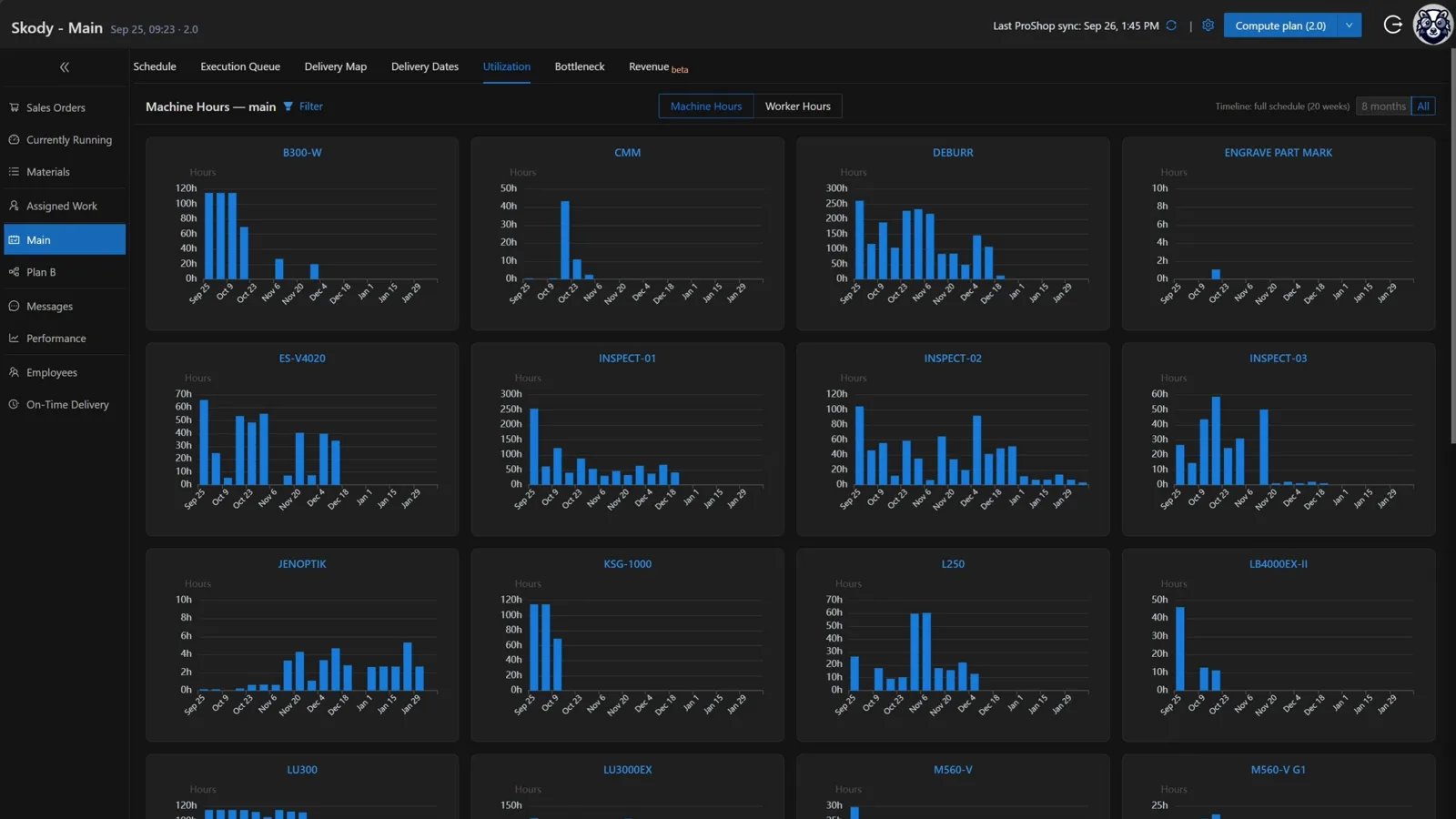
    Skody utilization view showing scheduled machine hours by resource across future weeks
    Example Skody view: scheduled workload by resource across the coming weeks and months.

    Machines + People

    Scheduled together

    Minutes

    To validate a changed plan

    Real-Time

    What-if scenarios

    Weeks Ahead

    See bottlenecks before they hit delivery

    About Yeager

    The problem was not knowing that the shop was busy

    It was knowing what to change.

    Yeager Manufacturing already had ProShop as its ERP. The challenge was turning the data in the system into a production plan that could survive what actually happens on the floor.

    A machine can be available while the right operator is not.
    Material can move.
    An employee can call out.
    A hot order can arrive.

    And a resource that looks overloaded is not necessarily the resource actually preventing a job from shipping on time.

    Yeager needed more than another static schedule. The team wanted to know:

    • What is actually limiting delivery?
    • Would adding another person help?
    • Would earlier material change the result?
    • What happens if somebody is absent?
    • If we change one constraint, where does the bottleneck move next?
    "
    We wanted something we could confidently send to our shop floor.
    β€” Zach Yeager, President, Yeager Manufacturing
    Zach Yeager, President of Yeager Manufacturing

    Zach Yeager

    President, Yeager Manufacturing

    The Story

    From "we think this is the bottleneck" to "let's test it"

    "
    Now in scheduling we run numerous scenarios in real time. We look at the dashboards Skody provides to see how we might solve the bottleneck. The real power is that in real time, we create a plan with the bottleneck fixed.
    β€” Zach Yeager, President, Yeager Manufacturing
    "
    For instance if we feel like if we had one more person running one of the mills we would be cruising… so we add Mill skills to a random person β€” usually an office employee just to test β€” and run a new schedule. Did our delivery date actually improve?
    β€” Zach Yeager, President, Yeager Manufacturing
    "
    If yes, wonderful but if no then we look at where the bottleneck is now and go solve that one. If we brought this material in sooner, would that help? And so on…
    β€” Zach Yeager, President, Yeager Manufacturing

    What-If Scenarios

    What-if scheduling at Yeager

    01

    What if we add another qualified operator?

    Yeager can temporarily change labor skills or availability and recompute the plan.

    The question is not whether another person creates more theoretical capacity.

    It is:

    Which customer delivery dates actually improve?

    If the dates do not materially change, labor in that area was not the constraint that mattered.
    02

    What if material arrives sooner?

    An open machine does not help if the required material is not ready when the operation needs to run.

    Skody lets the team change material readiness and recalculate the plan.

    The result shows whether earlier material actually improves completion dates or simply exposes the next constraint.

    03

    What if somebody is absent tomorrow?

    "If we have absenteeism, we plug it in and calculate/validate a new plan in a couple minutes."
    β€” Zach Yeager

    Skody removes unavailable labor capacity, recalculates the affected operations across the remaining machines and qualified people, and gives the team a revised plan to validate.

    04

    What if we take another job?

    The same planning logic can be applied before committing to new work.

    Keep today's plan as the baseline.
    Add the proposed order in a separate scenario.
    Recompute.

    Then compare what happens to existing customer delivery dates.

    The question becomes:

    Can we take this order without quietly making another customer's job late?

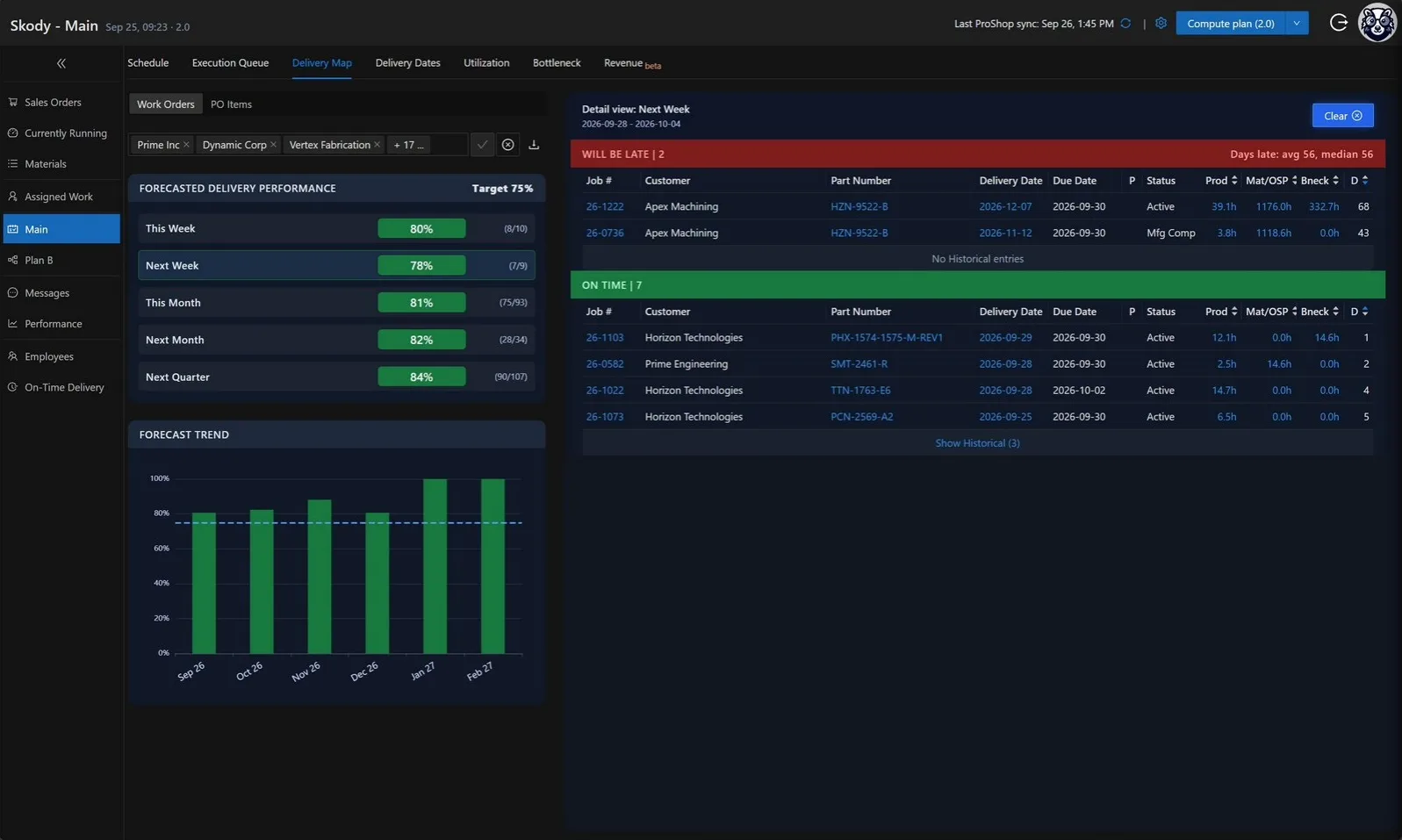
    Skody Delivery Map comparing forecasted delivery performance for a plan
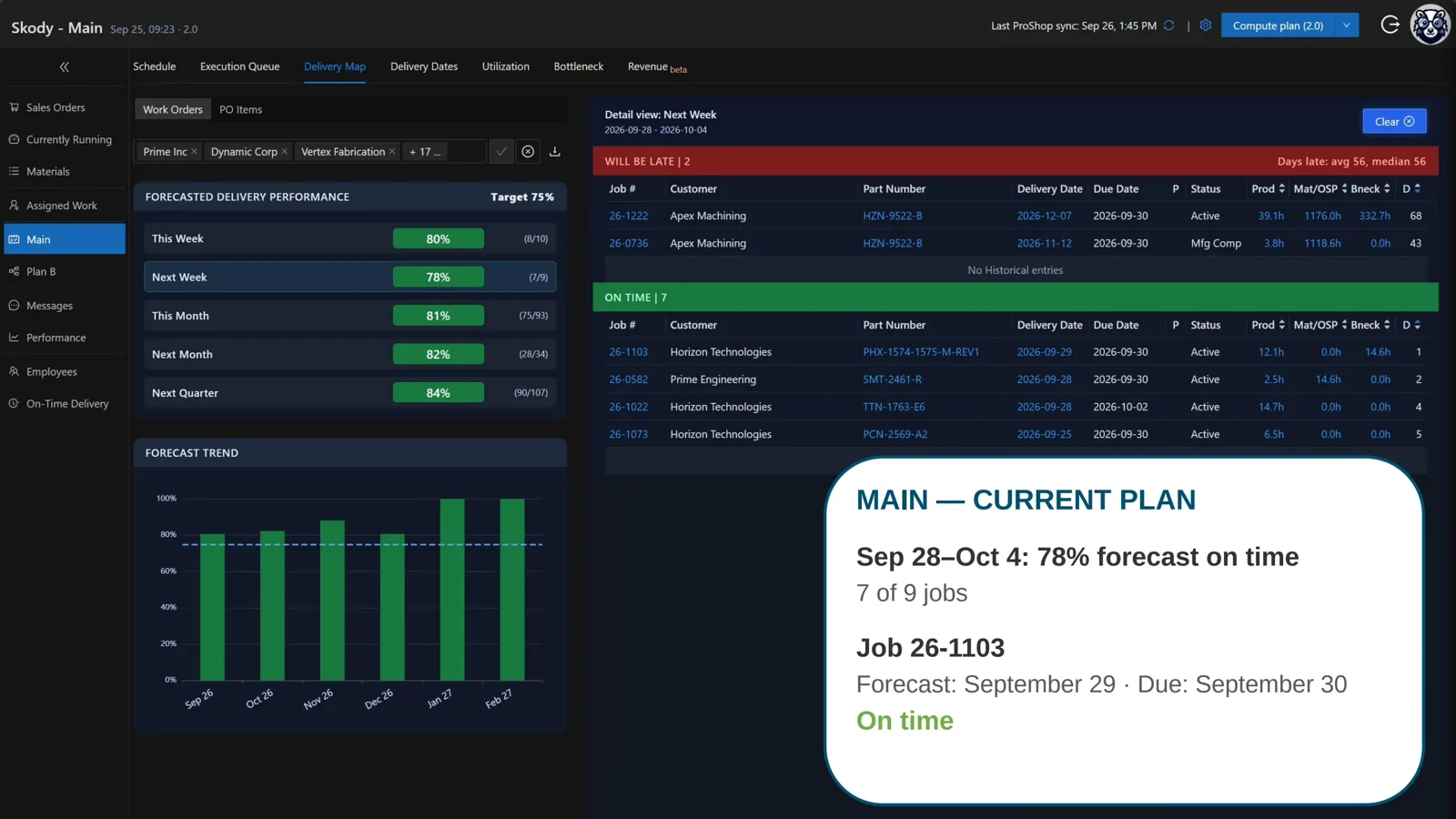
    Example Skody view: keep the current plan as the baseline and compare delivery dates for the same existing jobs.

    Example Skody plan-comparison workflow

    Skody Delivery Map for the current main plan
    1. Current plan
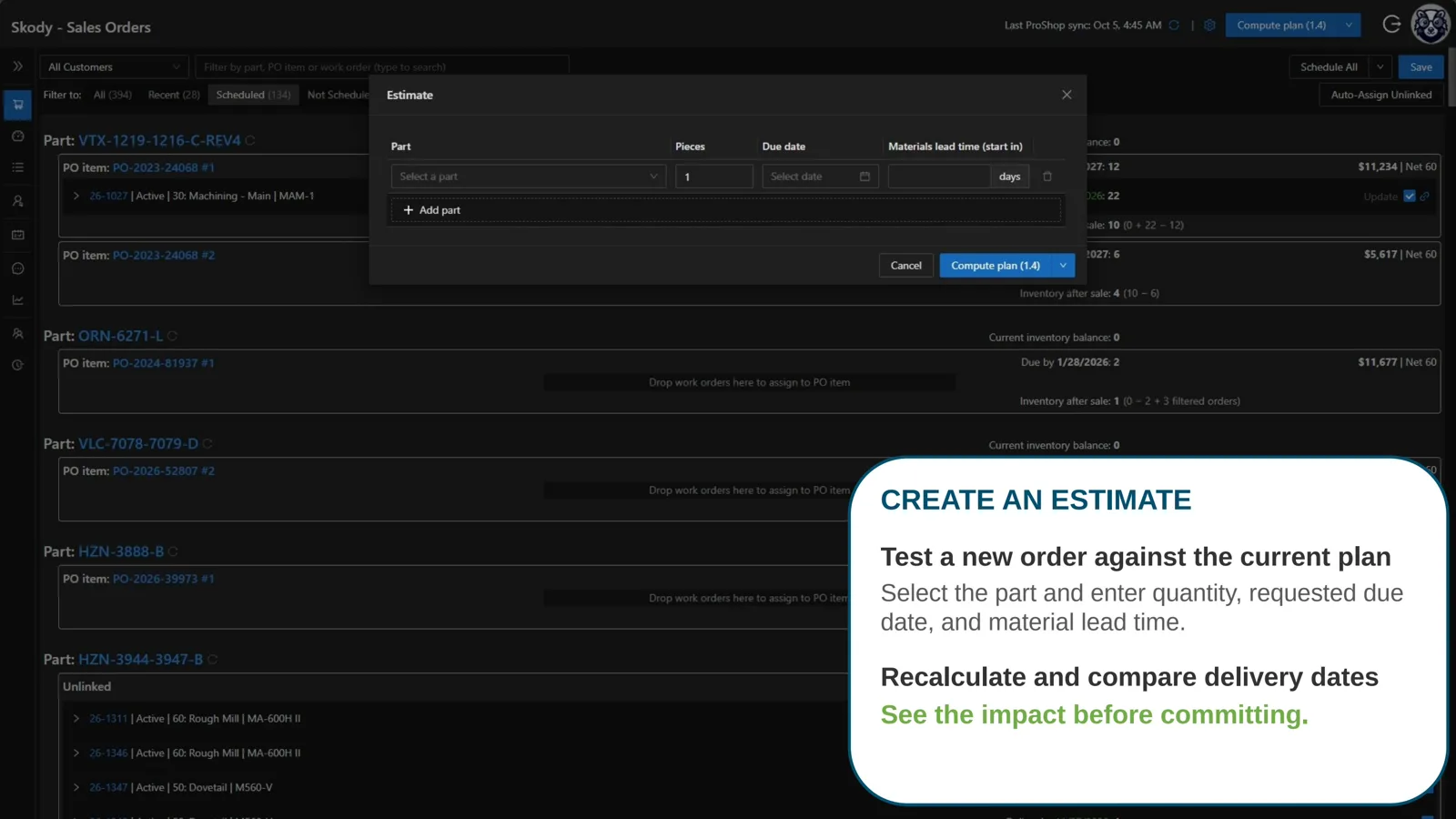
    Skody estimate dialog for testing a new order against the current plan
    2. Create an estimate
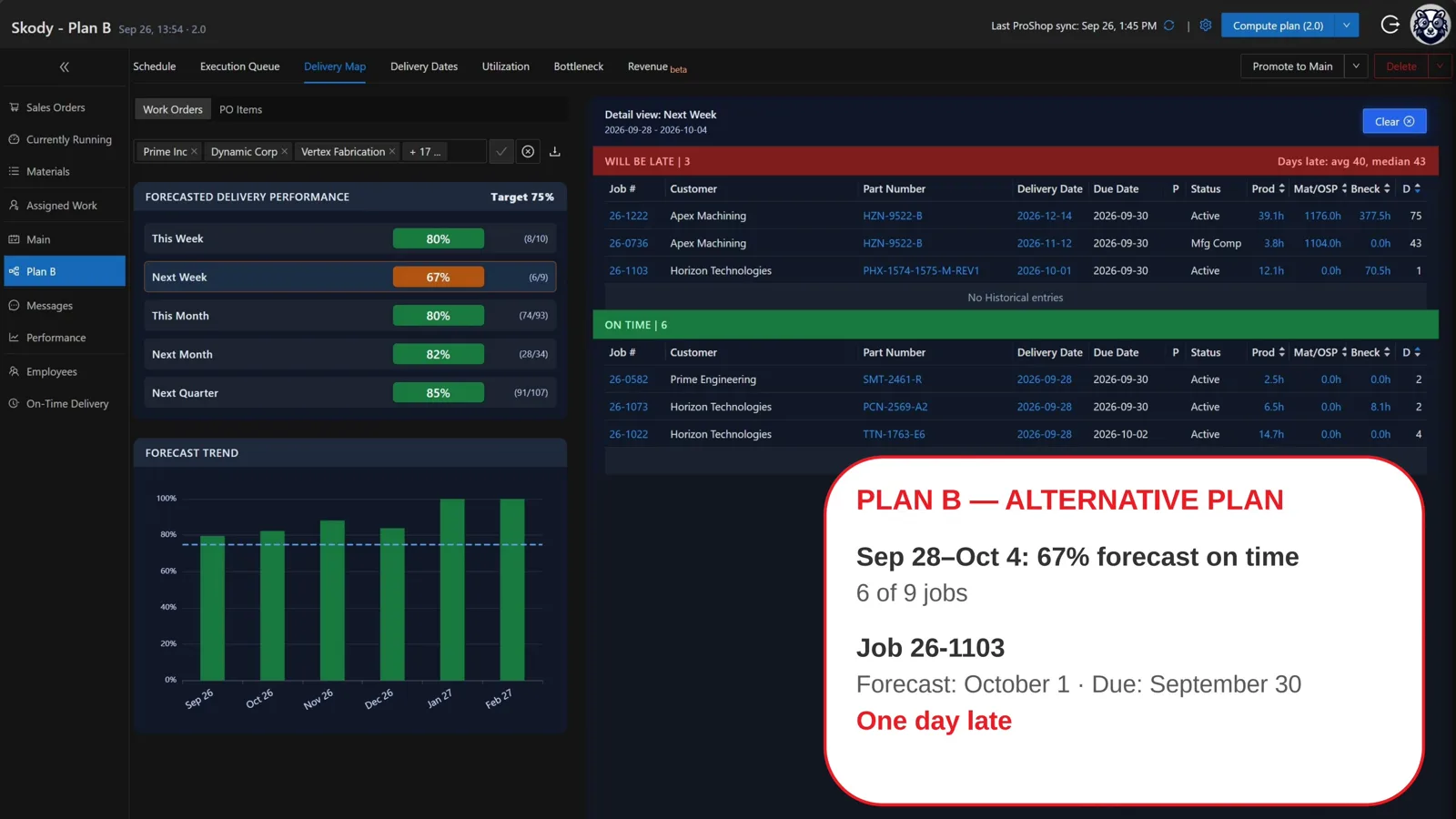
    Skody Delivery Map for an alternative plan
    3. Alternative plan

    Example Skody plan-comparison workflow. Jobs, customers and percentages shown are sample data, not Yeager production data.

    Constraints

    Sometimes the answer is not more capacity

    The obvious bottleneck is not always the constraint that matters to delivery.

    Yeager can test a proposed fix before acting.

    Add a person. Recompute.
    Move material earlier. Recompute.
    Change available capacity. Recompute.

    If the customer delivery dates improve, the team has evidence that the change matters.

    If they do not, the next constraint becomes visible.

    That changes the conversation from:

    "The shop feels overloaded."

    to:

    "This specific resource, during this specific period, is what prevents these jobs from shipping."

    Skody machine hours by resource across future weeks
    Example Skody view: capacity is specific to the resource and the period, not a shop-wide average.

    Scheduling Meetings

    Scheduling meetings became decision meetings

    "
    Sometimes scheduling goes great, and meetings are quick. Sometimes our backlog is nuts and we might run 8–10 of these scenarios in the hour long scheduling session.
    β€” Zach Yeager, President, Yeager Manufacturing
    "
    However, we come out of it with solid evidence that adding a resource in a specific area on a certain date would improve our OTD.
    β€” Zach Yeager, President, Yeager Manufacturing

    The point of the meeting is no longer manually constructing another schedule.

    The team can spend the time deciding:

    • Where is delivery risk developing?
    • What is causing it?
    • Which intervention actually changes the result?
    • What happens if nothing changes?
    • Which action gives the best improvement?

    Skody computes the schedule.

    The team decides what to do about it.

    Before and After

    Before Skody vs with Skody

    Before Skody

    • Look at reports and infer the bottleneck
    • Assume another person will help
    • Expedite work approaching its due date
    • Treat machine availability as capacity
    • Rebuild around absenteeism manually
    • Guess whether earlier material will help
    • Debate capacity changes

    With Skody

    • See the constraint in the finite plan
    • Add labor and recompute
    • See delivery risk weeks earlier
    • Schedule machine + qualified operator together
    • Remove unavailable labor and recompute
    • Change material readiness and compare dates
    • Test alternatives against the same baseline

    Machines + People

    Machines alone were not enough

    "
    What really stands out is how it accounts for both machines and people β€” not just a static schedule, but a worker-driven plan our team actually follows.
    β€” Zach Yeager, President, Yeager Manufacturing

    A machine being open does not mean an operation can run.

    The qualified operator must also be:

    • on shift
    • available
    • qualified for the operation
    • not already committed elsewhere
    • available when the machine and material are both ready

    Skody schedules those constraints together.

    ERP

    ProShop stayed the system of record

    Yeager did not replace ProShop to solve production scheduling.

    ProShop remains the ERP and system of record.

    Skody connects to the production data and handles the finite scheduling and decision layer across:

    • machines
    • people
    • materials
    • priorities
    • due dates
    • current production state
    ProShop
    Skody
    Shop Floor

    ProShop holds the work.

    Skody helps decide how that work gets executed.

    Running ProShop? See how Skody works with ProShop scheduling.

    Operational Change

    From expediting today's problem to solving next month's constraint

    Traditional expediting focuses attention on the jobs closest to becoming late.

    Finite forward scheduling lets the team look farther ahead.

    Instead of asking:

    "What do we need to expedite this week?"

    the team can ask:

    "What constraint five or six weeks from now is going to make us late?"

    That moves management attention upstream β€” while there is still time to change labor, materials, priorities or capacity.

    Operational Changes

    What changed in practice

    Bottleneck visibility

    See what is actually limiting delivery rather than infer it from historical utilization.

    Labor-aware planning

    Schedule qualified people and machines together.

    What-if planning

    Test additional labor, capacity, material timing or priority changes before acting.

    Absence recovery

    Change employee availability and validate a revised plan in minutes.

    Earlier intervention

    See delivery risk weeks before the affected orders reach shipment.

    Scheduling confidence

    Give the floor a plan based on current production conditions.

    "Our experience with Skody has been liberating."

    β€” Zach Yeager, President, Yeager Manufacturing

    Why It Matters

    A schedule should help you decide β€” not just tell you what is late

    A useful production scheduling system needs to understand:

    • current workload
    • existing customer commitments
    • finite machine capacity
    • qualified labor
    • operation sequence
    • material readiness
    • future bottlenecks
    • alternative plans

    But Yeager demonstrates the more important point:

    Once the production model is live, you can ask it questions.

    • What if we add someone?
    • What if material comes sooner?
    • What if somebody calls out?
    • What if we add capacity?
    • What if we take this job?

    Compute. Compare. Decide.

    FAQ

    Frequently asked questions

    Yeager uses ProShop as its ERP and Skody as the finite production scheduling layer.

    Yes. Skody models operator availability and skills along with machine capacity so an operation is not treated as executable simply because a machine is open.

    Yes. Zach describes temporarily changing worker skills in Skody, recomputing the schedule, and checking whether the delivery dates improve before making a real staffing decision.

    Availability can be changed and the production plan recomputed against the remaining machine and labor capacity. Zach says Yeager can plug absenteeism into the system and validate a new plan in minutes.

    Yes. Material readiness is part of the finite schedule. A shop can test an earlier material date and see whether it changes the order's calculated completion date or simply moves the constraint elsewhere.

    No. ProShop remains the ERP and system of record. Skody provides the finite production scheduling and decision layer on top.

    Stop guessing what would fix your schedule.

    See what happens before you move people, add overtime, expedite material or promise another order.