
Your Machines Are Busy. So Why Isn't Your Factory Producing More?
Why machine utilization is the wrong way to calculate manufacturing scheduling ROI.
By Alex Lebedev, Skody AI & Aaron Muhl, On Time Edge
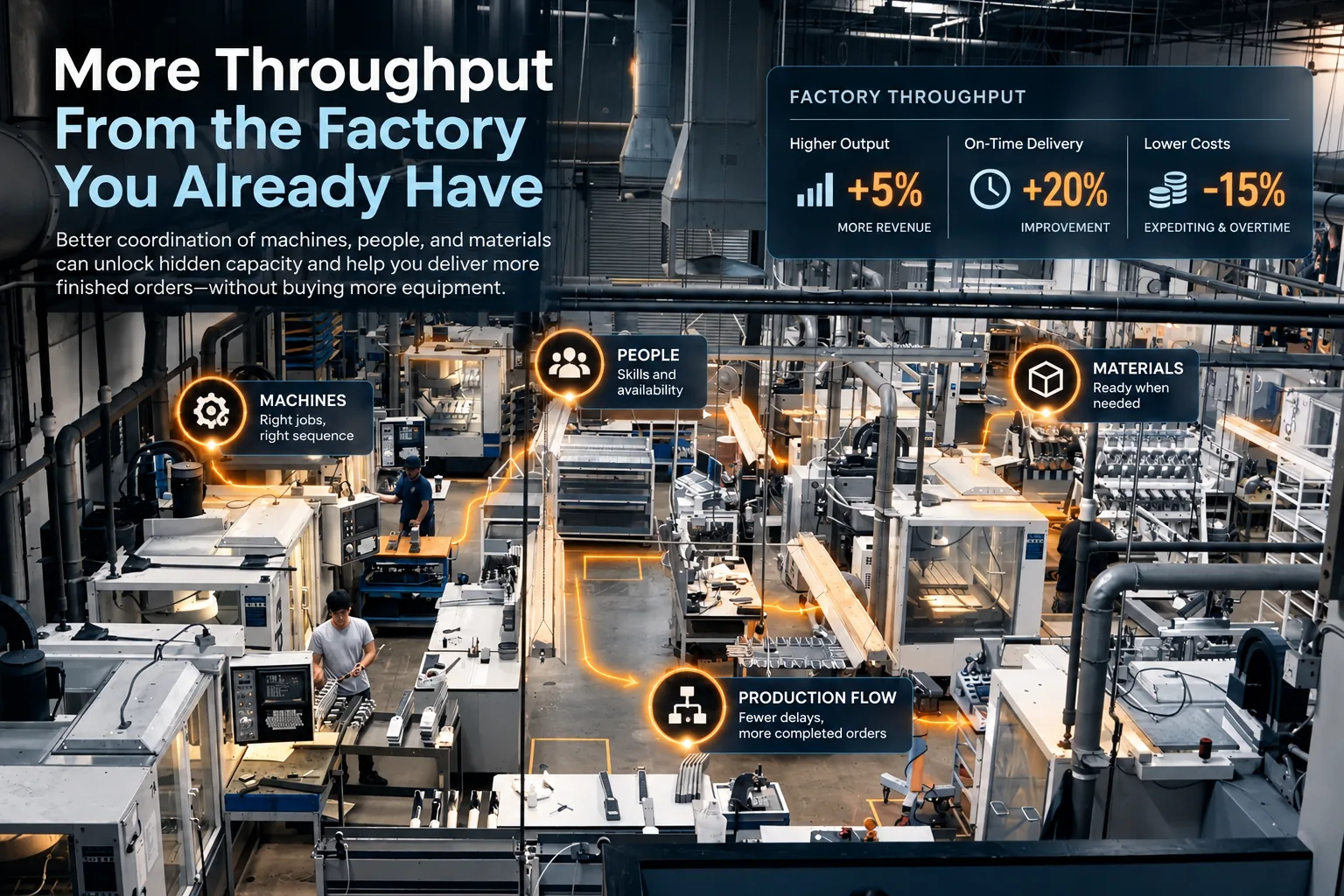
Introduction: The Utilization Trap
Imagine walking into a manufacturing facility.
Machines are running. Operators are working. Everyone looks busy.
Your utilization dashboard shows 85%.
But orders are still late.
Overtime is increasing.
And your production manager insists you need another machine.
Something doesn't add up.
Here's the problem: A busy factory is not necessarily a productive factory.
For years, manufacturers have measured scheduling performance using individual machine utilization.
But a factory isn't a collection of independent machines. It's an interconnected system.
Improving the performance of one machine doesn't necessarily improve the performance of the factory.
And that's why traditional production scheduling ROI calculations can be misleading.
The $250,000 Machine That Didn't Improve Production
Consider a hypothetical precision machine shop.
The owner notices that one CNC machine is consistently overloaded.
Jobs are waiting. Operators are frustrated. Delivery dates are slipping.
So the company invests $250,000 in another machine.
But six months later, overall factory output has barely changed.
Why?
Because the CNC machine wasn't the only constraint.
Perhaps inspection was already overloaded. Or qualified operators weren't available. Or production was being released in the wrong sequence.
Adding another machine increased capacity at one operation without increasing the number of finished orders leaving the factory.
The factory gained machine capacity. It didn't gain throughput.
That's the distinction that matters.
Think of Your Factory as a Living Organism
A factory operates as a connected system.
Machines depend on operators.
Operations depend on preceding operations.
Assembly depends on components.
Delivery depends on everything coming together at the right time.
Optimizing one resource independently can create problems elsewhere.
Running a machine at 95% utilization may actually increase work-in-process inventory if downstream operations cannot keep up.
Aaron Muhl of On Time Edge puts the distinction plainly: throughput is a property of the whole plant, not of any single machine.
"It's the overall capacity that manufacturers need to calculate, not individual machines. We need them thinking about their plant like a living organism, not individual organs."
What matters isn't keeping every machine busy.
What matters is keeping production flowing toward completed customer orders.
The objective should be maximizing profitable factory throughput while meeting customer delivery commitments.
That requires looking at machines, people, production sequences, due dates, and capacity constraints together.
Three Steps to a More Productive Factory
Analyze: Understand Before You Optimize
Better production decisions begin with understanding how machines, qualified workers, materials, and production priorities interact.
Skody allows manufacturers to evaluate different production scenarios, identify constraints, and make informed capacity decisions before committing resources.
Should you add another shift? Hire another operator? Invest in another machine?
The value here is better decision-making—not an artificial ROI calculation.
Stabilize: Make Delivery Predictable
Before maximizing output, manufacturers need a reliable production schedule.
Late orders create expensive consequences: expedited freight, overtime, customer penalties, and constant firefighting.
Skody helps manufacturers stabilize production and work toward a target of 99% on-time delivery. That is a goal, not a guaranteed universal outcome.
As delivery reliability improves, these avoidable costs can decrease substantially.
Maximize: Unlock More From Existing Resources
Once production is stable, manufacturers can focus on improving overall factory throughput—coordinating machines, people, and production sequences to increase finished, deliverable production without necessarily adding equipment.
A seemingly small improvement can create significant financial value.
For a $10 million manufacturer, a 2% throughput increase represents $200,000 in potential additional annual revenue.
At a 30% incremental contribution margin, that's $60,000 in potential additional annual contribution.
Treat 2% as an illustrative starting target. Continuous optimization can uncover further opportunities as factory conditions evolve.
These are illustrative figures, not guaranteed or verified customer results.
A Simple Example — Same Machines, Different Output
Consider a hypothetical factory with 30 machines operating across multiple departments.
The facility has sufficient equipment to manufacture $12 million worth of products annually.
But scheduling problems cause jobs to wait between operations, operators to compete for the same machines, and production priorities to change constantly.
The factory currently ships $10 million annually.
Now imagine better coordination allows the facility to increase completed output by 2% without adding equipment.
That represents:
| Metric | Annual value |
|---|---|
| Current production revenue | $10,000,000 |
| Factory throughput improvement | 2% |
| Additional potential revenue | $200,000 |
| Incremental contribution margin | 30% |
| Additional potential contribution | $60,000 |
The factory didn't need every machine to run 2% faster.
It needed the entire production system to work more effectively.
Over time, a 5% improvement on the same factory would represent $500,000 in additional revenue and $150,000 in contribution—a longer-term scenario, not a starting assumption.
An additional $60,000 in annual contribution is possible in this scenario—not because individual machines became more productive, but because more finished orders could move through the factory.
These figures are illustrative. The result assumes sufficient demand, available material and labor, comparable product mix, and genuine system-wide throughput improvement.
Why Traditional Scheduling ROI Calculators Miss the Point
Most manufacturing scheduling ROI calculators begin with questions such as:
- How many machines do you have?
- How many hours are they available?
- What's your utilization rate?
- How much is an additional machine hour worth?
These are useful operational metrics.
But multiplying additional machine hours by an hourly dollar value doesn't necessarily tell you how much additional revenue or profit the factory can generate.
A machine can become more utilized while finished production stays exactly the same.
For example, if an upstream operation produces 100 additional parts but downstream inspection can process only 50, the additional machine activity doesn't translate into 100 more shipped parts.
The distinction is between local efficiency and system-wide throughput.
A better ROI methodology begins with different questions:
- How much finished production can the factory currently deliver?
- What actually limits that output?
- Can better scheduling reduce waiting, conflicts, and idle time at critical resources?
- How much additional finished production could realistically be delivered?
- What would that additional throughput be worth?
Those questions connect scheduling performance directly to financial outcomes. (For the machine-hour view, see our CNC scheduling ROI calculator.)
What If You Could Test Capacity Before Investing?
This is where modern finite-capacity scheduling changes the conversation.
Instead of asking whether a particular machine is busy, manufacturers can evaluate the impact of different operational decisions.
What happens if we add an operator?
What if we move a job to another qualified machine?
What if we change the production sequence?
What if we introduce a second shift?
What if we accept another large customer order?
The important question isn't whether a change increases utilization.
It's whether that change improves the factory's ability to complete and deliver orders.
The Skody AI Scheduler brings machine and workforce capacity, skills, routing requirements, and production priorities together in a finite scheduling environment.
This allows manufacturers to examine the interaction between resources instead of optimizing each resource independently.
Where the necessary production data is available, manufacturers can evaluate scheduling alternatives before committing additional labor or equipment. See how manufacturers have done this in our case studies.
Not Every Factory Needs More Revenue
There is another important distinction.
More available capacity doesn't automatically translate into more revenue.
If customer demand is weak, producing additional products may simply create inventory.
For these manufacturers, the financial value of better scheduling may come from:
- Reduced overtime
- Less expensive expediting
- Fewer scheduling conflicts
- Lower outsourcing premiums
- Reduced planning effort
- Improved delivery reliability
The right ROI model depends on the factory's business situation.
For a manufacturer turning away orders, additional throughput can be extremely valuable.
For a manufacturer with stable demand, eliminating unnecessary operating costs may provide the greater benefit.
Either way, the calculation should be based on actual business impact rather than theoretical machine-hour value.
The New Way to Calculate Manufacturing Scheduling ROI
Start with factory output, not individual machine utilization.
Step 1: Establish current annual production revenue.
Step 2: Estimate realistic additional factory throughput. Use several scenarios rather than assuming a single improvement.
Step 3: Convert additional deliverable output into incremental contribution. Account for variable production costs, the ability to sell the output, and any additional labor or material requirements.
Step 4: Add measurable operating savings. Include reduced overtime, expediting, or other costs where justified, without double-counting benefits.
Step 5: Compare the financial benefit with scheduling software and implementation costs.
This creates a more meaningful estimate of scheduling ROI.
You can work through those steps with your own numbers in the Factory Performance & ROI Calculator.
It also establishes a basis for validating the opportunity using actual production data — which is what the Skody Production Scheduling Diagnostic is built to start.
Conclusion: Stop Measuring How Busy Your Machines Are
The most profitable factory isn't necessarily the one with the highest average machine utilization.
It's the one that converts its available resources into finished, deliverable products most effectively.
That requires understanding how machines, operators, production sequences, bottlenecks, and customer commitments interact.
The next generation of manufacturing scheduling isn't about maximizing individual machine utilization.
It's about maximizing what the entire factory can deliver.
And that's where the real ROI begins.
About the Authors
Alex Lebedev
Skody AI
Focus: AI-powered production scheduling, finite-capacity optimization, and manufacturing operations.
Aaron Muhl
Focus: Manufacturing operations, production scheduling, and factory performance improvement.
How Much Capacity Is Hiding in Your Factory?
Discover where production constraints may be limiting your output—and what better scheduling could unlock.